
Mazda MX-5 Miata RF | ‘A living Automotive Legand’, or ‘Is it Drop Top Season Yet?’
Every so often, a standout car comes along that not only defines its era but endures as an icon for generations to come.
The 1940s gave us the Jeep, the 1950s introduced the Corvette, and the 1960s saw the Mustang leave its unforgettable mark on the automotive world. After the emissions-choked land barges of the 1970s, the 1980s brought a fresh wave of automotive icons. Some, like the BMW M3 and Audi Quattro, cemented a legacy of European performance. Others, like the DeLorean DMC-12 and Pontiac Fiero, took bold swings that ultimately fell short. Still, each secured a unique place in automotive history—just not in the way their creators had envisioned.
By the early 1990s, American performance cars were enjoying a bit of a resurgence. The Foxbody Mustang was at its peak with the SN95 on the way, the Corvette ZR-1 was on the streets, and the Dodge Viper was coming in hot, even GMC was getting into the performance game with the short-lived Syclone and Typhoon.
Not to be outdone, Japanese automakers, having conquered the U.S. economy car market, were readying their own performance offensive—kicking off a golden era of Japanese sports cars and high-performance machines.
The NSX, “FC” RX-7, 3000GT, Supra, and WRX are just a few of the nameplates that dominated the performance headlines back in the day, each iconic in its own way. The RX-7 boasted a rev-happy rotary engine, the NSX proved that a supercar could actually be used as a ‘super’ car, and the Mitsubishi 3000GT was a technological marvel.


Believe it or not, the crossover brand you know—and probably don’t love—was behind one of the most advanced cars of its era. Twin-turbo V6, four-wheel steering, active aerodynamics, electronically controlled suspension, and an active exhaust—features that feel at home on a premium car in 2026 were downright futuristic in 1990.
But unfortunately, as good as they were, many of these cars didn’t make it out of the 90s. Sure, we’ve had a comeback or two; both the second-generation NSX and Supra were good, but neither of them had the impact of the originals.
As other automakers pushed the limits of innovation and speed, the Mazda MX-5 Miata launched in 1990 by steering toward a simpler, more classic formula inspired by classic British roadsters like the Lotus Elan and MGB. Marking the start of a new era for lightweight, affordable sports cars, the Miata delivered the same elemental joy of open-air motoring but with the added benefits of Japanese reliability and engineering precision. The feel of a British Roadster without the ‘finicky’ British engineering, I own an MG, I know the pain.

Mazda’s focus on the philosophy of “Jinba Ittai” — the harmony between car and driver — led to a back-to-basics formula: rear-wheel drive, a manual transmission, near-perfect weight distribution, and a simple, lightweight design that prioritized driving pleasure above all else.
Clearly, the formula worked. Unlike most 1990s Japanese sports cars, the Mazda MX-5 Miata has enjoyed a continuous 37-year run. And if Mazda’s indications hold, the upcoming fifth generation will carry on the lightweight, naturally aspirated formula that has made the Miata a fan favorite for decades—at least for one more generation.
So why, as I sit here in relentlessly cold New England with ice dams threatening my roof, do I bring up the Miata? Simple, really, like a lot of others, I’m daydreaming about a day when it isn’t 25 degrees outside, a day with some sun, a day I can drop the top on the MG and go for a ride. Because, although it is hard to imagine, spring will eventually be here in a few weeks, and then summer.

My daydreaming made me realize it’s been nearly nine months since my last Miata joyride. Nine months? Like they say, time slips by like sand through an hourglass—speaking of sand that also happened to be the color of the last Miata that I drove, Zircon Sand to be exact.
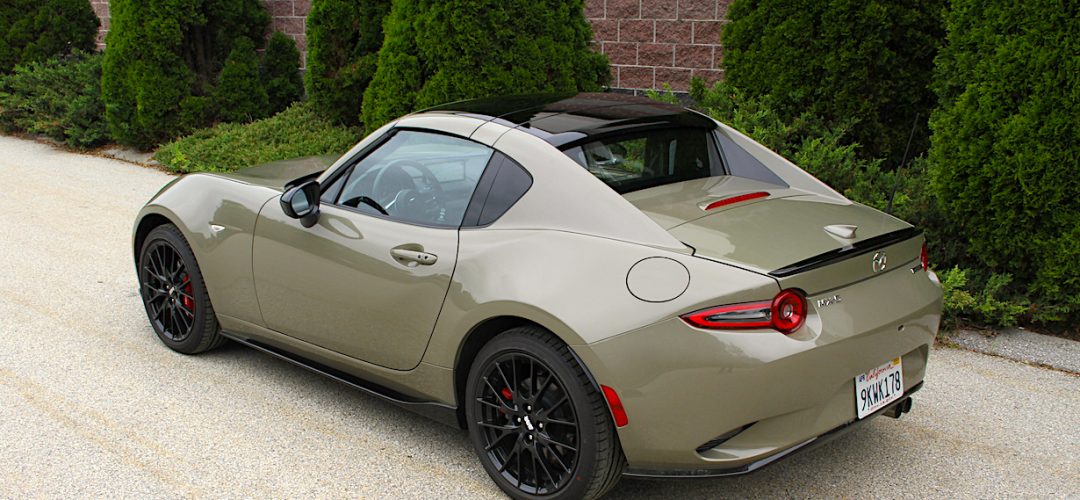
Although Soul Red may top the list of iconic Mazda hues, followed by Polymetal Grey, Zircon Sand ranks among my personal favorites. It’s the only color that truly looks right on the CX-50, and while its muted, earthy tone seems unexpected on the Miata, I think it works. Apparently, not many agree. The shade debuted for 2023 and quietly disappeared from the build page by 2025, giving it a brief two-year run.

Travelling back to June of 2025, this 2024 Mazda MX-5 RF Club in the aforementioned Zircon Sand was my ride of the week, and as you can imagine, it was a pretty good week.
You might be thinking, why would you review a two-year-old car in a discontinued color? But, I’m not going to review the Miata, though. Why? Because if you are still reading this, then you are likely already interested in it, plus there are 100s of awards in the Miata trophy case that say you should give it a try.
Also, there are a million-and-one reviews of the current (ND) Miata. I can sum up most of them in one sentence: The Miata is light, fun in corners, and still lets you shift it manually. The more whiny reviewers will tell you that it is cramped, rides rough over potholes, and needs a turbo. Don’t listen to those guys, they don’t get it.

Here’s the bottom line: if you are on the fence about buying a Miata, go drive one. Do you fit? Do you think it is underpowered? Can you drive it every day? Will your wife squawk because you bought a car with a manual and she can’t drive it? Go drive it and find out, also if your wife doesn’t like it, she can drive her RAV4…
While I don’t care to write a review, I can tell you a bit about the Miata MX-5 RF Club that Mazda lent us.
For those not in the know, the RF is a two-seat roadster for people who might not be that dedicated to the soft top life. Introduced at the 2017 New York Auto Show, the MX-5 Miata RF features a power-retractable hardtop that more or less turns the roadster into a targa-style coupe.


At $41,900 (2026 MSRP), the RF Club sits at the high end of the Miata lineup. While all Miatas leave the factory with the same 180-horsepower 2-liter 4-cylinder engine, the RF Club trim adds a few performance bits, such as Brembo front brakes, BBS forged wheels, and heated RECARO sports seats. The Club also gets a front shock tower brace for added reinforcement. An automatic transmission is not offered on the Club; for that, you have to move up to the Grand Touring trim. Why do you want an automatic in an MX-5 anyway?

The Club trim is also available on the MX-5 Roadster if you prefer, but unlike the RF Club, most of the performance add-ons come as part of an optional package. I’m sure there is some automaker pricing logic involved, but if you’d like the Brembo Brakes, BBS wheels, and RECARO seats on the Roadster Club, you need to add them as part of a $5050. package, aptly called the BREMBO/BBS RECARO package. This bumps the $35,760 MSRP of the MX-5 Club to $40,810.


If you’ve been thinking about buying a new Miata, now might be a good time to get to the dealership. First, it’s been a slow sales month for Mazda, so it might not be busy at your local dealership (no, you won’t be getting any discounts on the MX-5). Second, if you plan on buying a new Miata, local in-stock inventories are thin, so you may end up waiting three or four months if you order one. Summer isn’t that long…as they say, act now!


- Mazda MX-5 Miata RF | ‘A living Automotive Legand’, or ‘Is it Drop Top Season Yet?’
- 2025 Ford F-150 Lightning Platinum
- 2025 Toyota Grand Highlander Platinum Hybrid Max
- 2025 Nissan Murano Platinum AWD
- 2025 Mitsubishi Outlander SEL 2.5 S-AWC


No Comments
No comments yet. You should be kind and add one!