

The current administration declared war on EVs by killing tax credits and halting electric vehicle infrastructure development, but that doesn’t mean that the rest of the world is walking away from clean energy or giving up the momentum electric vehicles have built over the past few years. The 2026 New York Auto Show provides important evidence of that.
Held at the Jacob K. Javits Center in Manhattan, the auto show runs until Sunday, April 12, and although the overall theme appears to be focused on off-pavement adventures, a few automakers made it clear that, for them, the shift to EVs is more than just a marketing gimmick.
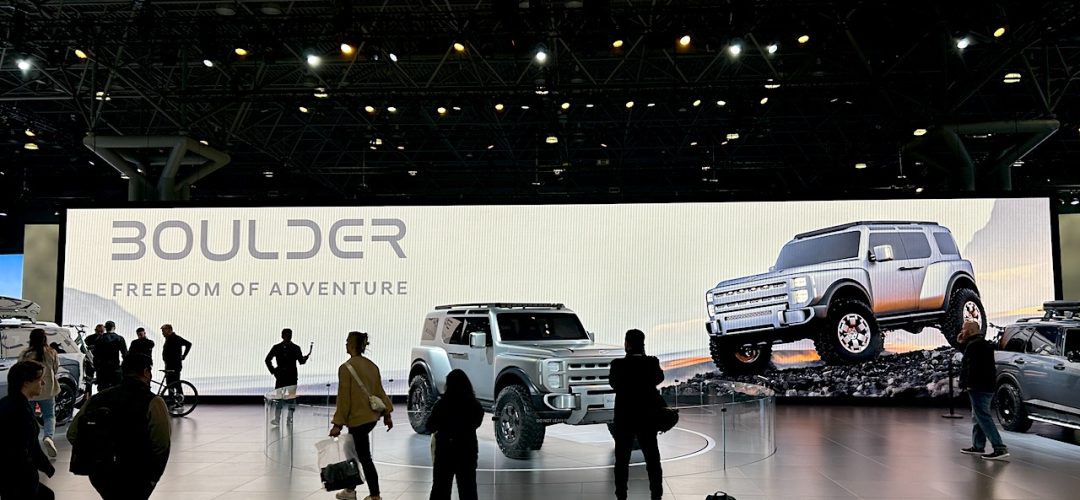
This year’s lineup showcased a wide range of electric vehicles — from an entry-level Kia that’s already making waves globally and a family-friendly 3-row Subaru aptly named Getaway to an all-electric Kia minivan with the clear purpose of offering ADA accessibility. Plus there’s the show-stopping Hyundai Boulder SUV concept that we’re betting on coming out as an EV.
2027 KIA EV3 | The Entry-Level EV Challenger

The 2027 KIA EV3 reinforces Kia’s commitment to electrification. It’s a significant step, as the EV3 isn’t a performance car or a large SUV — it’s an entry-level EV that brings the technology and styling cues found on Kia’s higher-end electric models.
You might think that the EV3 looks a bit familiar, and you’d be correct. When it comes to looks, the EV3 borrows heavily from Kia’s 3-row EV9 SUV. And that’s not an insult; the EV9 is one of the best-looking EV SUVs on the market.


Like the EV9, the EV3 shares Kia’s evolving global Opposites United design philosophy, featuring broad front-end styling framed by horizontal small cube LED projector head lamps. Of course, it’s an EV, so the design of the EV3 needs to help maximize efficiency. Flush roof rails come standard, as do the flush front door handles and hidden rear door handles.
Kia says that the styling of the EV3 “juxtaposes contrasts found in nature with those of the human and industrial world.” I’m not sure I see that, but I can tell you that they have pulled off a design that truly looks tech-savvy without going overboard.
Inside, the EV3 features a low floor for maximum cargo space and a standard panoramic display composed of dual 12.3-inch screens plus a 5-inch climate control display.


A flexible center console includes retractable cupholders and both open and closed storage compartments. There’s also a small front truck.

Naturally, when it comes to EVs, most people want to hear about range. Built on Kia’s dedicated 400-volt E-GMP platform, the EV3 offers a choice of batteries: a standard-range 58.3 kWh battery (FWD only) or a long-range 81.4 kWh battery (FWD or e-AWD, optional on Wind and Land and standard on GT-Line and GT). Kia estimates that the 58.3 kWh battery will provide up to 220 miles of range on a full charge, while the 81.4 kWh battery delivers up to 320 miles (FWD).
When using a properly equipped DC Fast Charger, the standard-range EV3 can be charged from 10 to 80 percent in an estimated 29 minutes. The long-range battery takes a little longer to charge, but not much, charging from 10 to 80% in 31 minutes.

The EV3 utilizes Tesla’s North American Charging Standard (NACS), giving drivers access to one of the most well-developed charging networks available. Kia has also been thoughtful with charge port placement, positioning it on the passenger-side front fender so drivers can pull straight into a Tesla Supercharger and plug in with ease—no awkward cable stretching required.
2027 Subaru Getaway | All-Electric, Adventure-Ready, 3-Row SUV
You gotta admit it, if you are planning to build an adventurous, family-friendly 3-row SUV, Getaway is the perfect name.

Developed in partnership with Toyota, the Subaru Getaway shares quite a bit with the upcoming Toyota Highlander EV and expands on the Toyota/Subaru relationship, which also includes the Toyota 86/Subaru BRZ, Toyota bZ/Subaru Solterra, and Toyota C-HR/Subaru Uncharged. It’s also the fourth BEV in the Subaru lineup.


While the overall design of the Getaway echoes the Highlander, I prefer Subaru’s front fascia with its softer lines and larger, horizontal LED daytime running lights. It may seem a bit backwards considering that Subaru is the off-pavement-focused brand, but I believe the Getaway achieves a more elegant look when compared to the Highlander’s sharper, tech-inspired design.


Of course, a Subaru has gotta Subaru, so there are some company staples that you’ll find on the Getaway, including the obligatory 8.3 inches of ground clearance, robust ladder-type roof rails (standard on most trims), and Standard Subaru Symmetrical All-Wheel Drive with the X-MODE Dual-Mode System (featuring Snow, Dirt, Deep Snow, and Mud Modes), Grip Control, and Downhill Assist Control.

I’ve said many times that one of the greatest benefits of an EV is the flat floor, which is why EV SUVs make the best family haulers outside of the minivan segment.
Inside, the Getaway includes seating for 6 with standard second-row captain’s chairs, or available seating for 7 with a second-row bench seat. No matter which seating you choose, all trims include one-touch, second-row folding seats for easy access to the third row. Cargo space tops out at 15.9 cubic feet behind the third row; folding the third row opens up 45.6 cubic feet.


Tech-wise, the Getaway features a standard 14-inch Subaru Multimedia touchscreen, with wireless Apple CarPlay and Android Auto. Dual, console-mounted wireless phone chargers are available.
Most importantly, all trims come with EyeSight driver-assistance technologies, including Pre-Collision Braking, Blind Spot Monitoring, Lane Departure Alert, Emergency Stop Assist, Traffic Jam Assist, Lane Change Assist, and Adaptive Cruise Control.
As I mentioned before, all-wheel drive comes standard and features independent, front and rear electric motors to deliver a combined 420 horsepower. By comparison, that’s on par with the gas-powered Cadillac Escalade, and 160 more horsepower than Subaru’s own Ascent 3-row SUV. Subaru says this combination can propel the Getaway from 0 to 60 in under 5 seconds. That’s WRX territory. If you plan on driving that way with occupants in the third row, you might want to head over to Amazon and pick up some barf bags.
Initially, the 2027 Subaru Getaway will be powered by a long-range, 95.8-kWh lithium-ion battery; a smaller 77.0-kWh battery option is expected sometime in 2027.
The Subaru Getaway is also rated to tow up to 3,500 pounds.

Subaru expects the long-range battery to deliver over 300 miles on a full charge. Like the Kia EV3, the Getaway features the North American Charging Standard (NACS) charge port and can charge from 10 to 80% in about 30 minutes. A standard on-board battery preconditioning system ensures charging performance doesn’t lag in cold-weather conditions.
KIA PV5 WAV / BraunAbility Concept | Purpose Build EV Transporter

The Kia PV5 WAV (Wheelchair Accessible Vehicle) was the other new EV in the Kia booth. It’s not meant to drift, burn up the Nurburgring, or make TikTokers swoon; no, it’s much more important than all of that.
Partnering with BraunAbility, a pioneer/leader in handicapped mobility since 1962, the PV5 WAV melds advanced technology with innovative design to serve an underserved segment of the transportation sector.
If you are not familiar, the PV5 is a European/South Korean market all-electric minivan based on Kia’s Platform Beyond Vehicle (PBV). Kia’s PBV program is a phased initiative focused on delivering smart, modular, customizable mobility solutions for both passenger and cargo use, with the PV5 serving as the first phase of that strategy.
While a Car & Driver article showing a PV5 prototype with what appeared to be U.S.-spec lighting undergoing testing in Michigan has fueled speculation about a potential U.S. launch, Kia has downplayed the rumors. A company spokesperson told the magazine, “PV5 testing in the U.S. does not imply plans for its sale in this market.”
Turns out Car & Driver may have been onto something. According to Kia, the ADA-compliant PV5 WAV concept shown at the New York Auto International Show will begin real-world testing in New York City, gathering feedback and refining the vehicle based on input from government agencies, disability advocacy organizations, and fleet operators.
The Kia PV5 WAV / BraunAbility Concept exemplifies the benefits of a low-cost, customizable EV platform with a low load floor and compact drivetrain with no fuel or exhaust components to modify.


It’s also packed with smart features, including the Simple Stow Ramp, integrated securement, laser and ultrasonic guidance, along with a low step-in height, and dual sliding doors for easy curbside boarding.


Modifying a gas-powered van like the Chrysler Voyager or Pacifica is extremely costly, requiring extensive structural changes that can add more than $25,000 to the base price. For example, a ‘new’ 2024 Chrysler Voyager equipped with a rear-entry ramp conversion retails for $64,995, compared to the $37,000 MSRP of a Voyager LX in 2024. Even in the used market, converted wheelchair accessable vans bring in big bucks; it’s actually shameful that no automaker has offered an affordable over-the-counter solution. Hopefully, Kia makes this happen with the PV5 WAV.
It’s estimated that over 5.5 million people in the U.S. use a mobility device of some kind. It’s past time that someone introduces a lower-cost, purpose-built wheelchair-accessible vehicle, and while pricing hasn’t been announced, it’s encouraging to see Kia and BraunAbility pushing the conversation forward.

Beyond the functional benefits of an all-electric accessibility vehicle, the PV5 WAV could also help taxi operators meet New York City’s zero-emission fleet goals.
Hyundai Boulder SUV Concept | An Offroad-Ready Preview of Hyundai’s Rugged, Body-On-Frame Pickup Future

The Hyundai Boulder SUV Concept was undoubtedly the surprise star of the 2026 New York Auto Show, but here’s the thing: while I include it on my list of EV debuts, it might not be an EV. So what’s the point of including it?
First, it’s an important vehicle. While we may not see an SUV version, the Boulder serves as a design preview for an upcoming fully boxed, body-on-frame midsize pickup that Hyundai aims to bring to market by 2030.


Fully-boxed body-on-frame? Why does that matter?
First and foremost, a boxed steel frame is inherently rugged, which is why vehicles like the Wrangler, full-size Bronco, and most work-ready pickup trucks are built on steel frames.
Hyundai’s goal is to build vehicles that cater to off-road enthusiasts and attract new buyers to the brand.
“Body-on-frame vehicles are the backbone of American work and adventure, and we intend to compete in the midsize pickup segment with everything we have. The body-on-frame truck is one of 36 new Hyundai vehicles coming to North America by 2030. We are entering segments we have never competed in before, and we are doing it the right way: designed in America, built by Americans for American customers.” said José Muñoz, President and CEO of Hyundai Motor Company.

With its boxy, upright design, aggressive approach/departure/breakover angles, and 37-inch tires with tailgate-mounted full-size spare, the Boulder certainly screams rugged and off-road-ready.
While I can appreciate the styling, I wish that Hyundai had chosen a color other than silver for the grille. Something about the color makes it look fake. Might also be the headlights; they remind me of 1:24 scale model car headlights that you have to glue in place.

The back end gives off a bit of a Toyota FJ vibe and features a cool double-hinged swing-out rear door that opens from either side. As a long-time Wrangler owner, I can attest to how handy this would be to have on a Jeep.

So, is it an EV or not?
That’s the funny thing, I have no idea, and seemingly neither does Hyundai, because it is not mentioned anywhere in the press info, nor do I remember it being mentioned during the reveal.
Speaking to the Automotive News Daily Drive podcast, Hyundai North America president and CEO Randy Parker was asked about Boulder powertrain options, and although nothing is locked down, they are open to internal combustion, electric, hybrid, or some combination.
“It could be all of the above. What we are trying to do right now is do things the right way, by listening to our customers, and we are going through many, many focus groups to better understand what our consumers’ expectations are in this space, whether it’s powertrains, fuel efficiency, capability, and performance, we’re really right now focused on learning from the customer, meeting customer expections and then we will decide on which powertrain direction and derivatives we want to go in.” ~ Randy Parker, Hyundai North America president & CEO speaking on Automotive News, Daily Drive
Fine, said.
Possible EV powertrain? We’ll say…definitely maybe.
Realistically, if Hyundai wants to take a bite out of the Jeep / Bronco / 4Runner marketplace, here’s my advice: low base price, simple base powertrain, real capability.
The 2026 New York International Auto Show runs from April 3 to April 12.


