
by Peter Ciani
If the Standells are to be believed, the only thing you might find on the banks of the River Charles, besides the lead singer, are lovers, muggers, and thieves. While I’m sure those folks are still around somewhere, they were nowhere to be found as the 2026 Head of The Charles Regatta kicked off…shoved off…got underway?
But this is a car site, you say. Have we moved on to covering boating events? Heck no, I know nothing about rowing; when someone tried telling me about thier coxswain; I thought they were being rude (Google it). Awful rowing joke aside, we came to Beantown last weekend to celebrate the revival of a 1960s automotive icon – the Scout.
While the Jeep Wrangler has long enjoyed the spotlight and the Ford Bronco has made its own comeback, the Scout has been missing from the U.S. market for 46 years. It’s an automotive tragedy that the newly formed Scout Motors is looking to correct, bringing the nameplate back as a rugged, adventure-ready vehicle with all-electric and range-extended powertrains.
Originally launched under the International Harvester brand in 1961, the Scout was developed to compete with Jeep’s utility-focused CJ. The new generation won’t carry the International Harvester name, which isn’t surprising given the company’s long and complicated history. Plus, IH as a brand is long gone. International Harvester sold off its agricultural equipment business in the 1980s, while its remaining truck and engine operations became Navistar International Corporation in 1986.

IH Scout production ended on October 21, 1980. Coincidentally 46 years to the day we are publishing this story. Back then, Navistar retained the rights to the Scout name but, with its focus on commercial trucks and diesel engines, the Scout seemed destined for the dustbin of automotive history. Following a series of corporate changes, however, the Scout brand eventually landed in Volkswagen’s hands in 2021. Volkswagen’s chief operating officer at the time, Johan De Nysschen, reportedly floated the idea of reviving the nameplate soon after.
Consequently, Scout Motors was founded in 2022 as an independent EV manufacturer backed by Volkswagen AG. Although it’s part of the Volkswagen Group, Scout Motors has its own leadership and considerable independence in designing, engineering, and manufacturing its vehicles. For a clean-sheet EV startup, that’s a good thing, particularly given Volkswagen’s somewhat “complicated” internal governance structure.

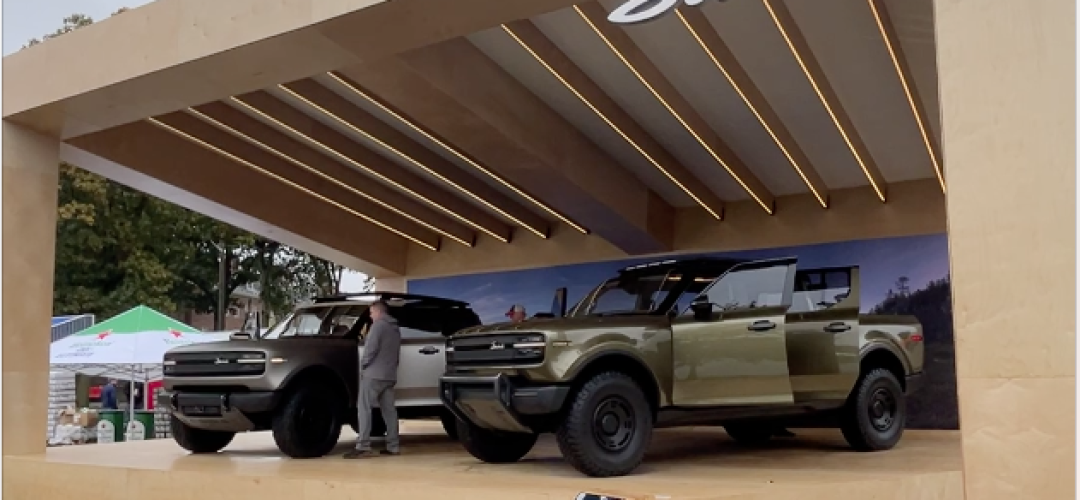
So, why were three production-intent Scout prototypes on display at the Head of the Charles? Simple: Scout Motors was named the event’s Official Automotive Partner.
“The Head Of The Charles brings together people who love adventure, the outdoors, and the dedication it takes to pursue those passions,” said Scott Keogh, President and CEO of Scout Motors. “We’re excited to introduce our Scout brand to New England at such an iconic event and give fans a chance to see our vehicles up close while cheering on world-class athletes.”
The Head of the Charles drew nearly 12,000 competitors from around the world and an estimated 375,000 to 400,000 spectators. That’s a lot of eyes on what could be a prime market for a pair of adventure-ready EVs.
With displays at two locations – Riverbend Park in Cambridge and across the river near the Eliot Bridge Enclosure hospitality tent – Scout Motors brought along three prototypes. Two were Traveler SUVs: one outfitted with practical off-road accessories, including a spare tire carrier and fuel can, and the other configured as more of an elegant, “goin’-ta-town rig”, as Vice Grip Garage’s Derek Bieri might say.


Yes, it is funny to see a gasoline can hanging off of the back of an EV, but it makes sense if you consider that there will be versions dubbed the Harvester with a gas-powered range-extending generator.
The Terra pickup was also on hand, outfitted for adventure with a roof rack featuring integrated lights, a toolbox packed with useful accessories, and oversized 37-inch off-road tires. Scout representatives were quick to point out that 37-inch tires won’t be offered on the production model, explaining that they simply wanted to demonstrate how well the larger tires fit the truck. I’ll take them at their word, but it does make me wonder if sketches for a future off-road performance variant are already kicking around the Scout Motors design studio.


Production Terras are expected to include standard 33-inch all-terrain tires, with an optional 35-inch setup planned. Scout also intends to offer an under-bed spare tire carrier for models equipped with 33-inch tires, while trucks fitted with the larger 35-inch tires will have an optional in-bed carrier. How is it that, after nearly 150 years of automotive innovation, in the year 2026 we’re excited to see a vehicle that might actually come with a spare tire?
As a Scout fan, I tried to put in my request for a true Bronco-fighting convertible or an extended-wheelbase, three-row Travelall. The response was something along the lines of, “We have to get these products off the ground before we think about anything else.” Which is a polite way of saying, “We know, we know. Stop asking.”
The overall styling of the Terra and Traveler clearly draws inspiration from the original Scout vehicles, but the design team also wanted to avoid going too retro. The goal was to pay homage to the originals while appealing to modern tastes. These are production-intent concepts, so details could still change, but I think they nailed the design.
Inside, Scout emphasizes simplicity and ease of use. The instrument panel features a horizontal design with pronounced upper and lower brows. Beneath the Scout Community UX center touchscreen, a row of toggle switches and knobs provides easy access to climate and audio controls.
Natural materials such as wood trim, leather, and textiles help create a modern, adventure-ready cabin. Scout’s design team wants these materials to retain their authentic character. “Natural materials should look and feel natural, leather may show its markings, wood may reveal its grain. And textiles may carry the texture of real fibers,” said Senior Designer Peyton Sullivan.


Drawing inspiration from the orginal brand’s agricultural heritage, including work boots and denim jeans, Scout blends vintage influences with modern design. But like the exterior, they have found ways to incorporate the past without getting stuck in it. The Terra pickup’s seating is one example, reinterpreting typical perforated leather upholstery with a plaid pattern reminiscent of 1970s automotive interiors. Plaid interiors were great; the world needs more plaid.

Scout models will also offer a choice of seating configurations. A six-passenger layout features a full front bench seat, while a five-passenger arrangement adds a center console with convenient storage. Scout has not yet specified which configuration will be standard.

There’s also an old-school compass integrated into the overhead switch panel, because its cool, that’s why.
On the engineering side, we were surprised to hear that Scout Motors has chosen to develop its own proprietary electric platform and body-on-frame chassis, complete with a solid rear axle and standard rear mechanical locking differential. Given Volkswagen’s partnership with Rivian, Scout Motors could have hit the ‘easy button’ and adapted Rivian’s skateboard platform, but it chose to go its own way.


One reason for taking a different approach to the chassis and drivetrain is off-road durability. While a Rivian is certainly no slouch off-road, Scout wants its vehicles to deliver serious capability in the most demanding conditions. That’s where a rigid steel frame comes in. If you want to build a truck or SUV that can tow, haul, and take a beating, you need a solid foundation. Underneath that frame, you’ll find a solid rear axle supplied by American Axle & Manufacturing.
AAM’s rear e-Beam axle essentially builds on a history of heavy-duty axle expertise, dragging truck axles into the future by integrating a complete EV drive, including a high-speed electric motor, gearbox, and inverter unit, into a compact solid axle that can be easily hung under almost any truck frame. The front uses an independent suspension. A mechanically locking rear differential comes standard; a front locking differential will be offered as part of an optional off-road performance package.

Although Rivian won’t be supplying any of the mechanical components, Scout will be making use of Rivian’s software expertise and zonal electronics architecture. Rivian introduced its zonal electronics architecture in their second generation R1T and R1S as a way to reduce costs, manufacturing complexity and weight.
Rivian’s second-generation R1T and R1S switched from a domain-based electrical architecture to a zonal architecture, organizing many vehicle functions around physical locations rather than separate functional controllers. In the earlier design, a controller responsible for a function such as lighting could require wiring that ran throughout the vehicle to reach individual lights. With zonal control, controllers positioned in different areas manage the local inputs and outputs, reducing the need for long wiring runs. This approach helped Rivian reduce the number of electronic control units (ECUs) from 17 to seven and eliminate approximately 1.6 miles of wiring. Combined with ECU consolidation, the redesign removed about 44 pounds of weight per vehicle.
It’s a bit early to talk about specs. You can find some numbers on the Scout website, but nothing is set in stone yet. Scout is targeting nearly 1,000 lb-ft of torque, with the all-electric models expected to have a battery capacity of around 120–130 kilowatt-hours. Range-extended models are expected to use a smaller battery pack of approximately 60–70 kilowatt-hours.
The all-electric Scout models are expected to deliver approximately 350 miles of range on a full charge, while range-extender models are targeting up to 500 miles. These figures are preliminary and subject to change, with final range estimates likely to vary depending on configuration, including tire size and optional accessories.
Scout Motors originally planned to begin production near the end of 2026, but pushed its initial production target to 2027, with the Traveler SUV expected to lead the launch. Delays aren’t unusual for a startup, and Scout Motors appears willing to push back its timeline rather than rush a half-baked product to market.
We’d like to thank Scout Motors for inviting us to get an up-close look at the Scout Terra and Traveler concepts. We look forward to seeing the production models when the day comes. Perhaps someday we’ll strap a boat to the roof of a Traveler and head over to the Charles for a rowing lesson.
You gotta love that dirty water!


No Comments
No comments yet. You should be kind and add one!